
Cette page n'a pas encore été traduite ; son contenu est donc affiché en anglais.
01
Présentation
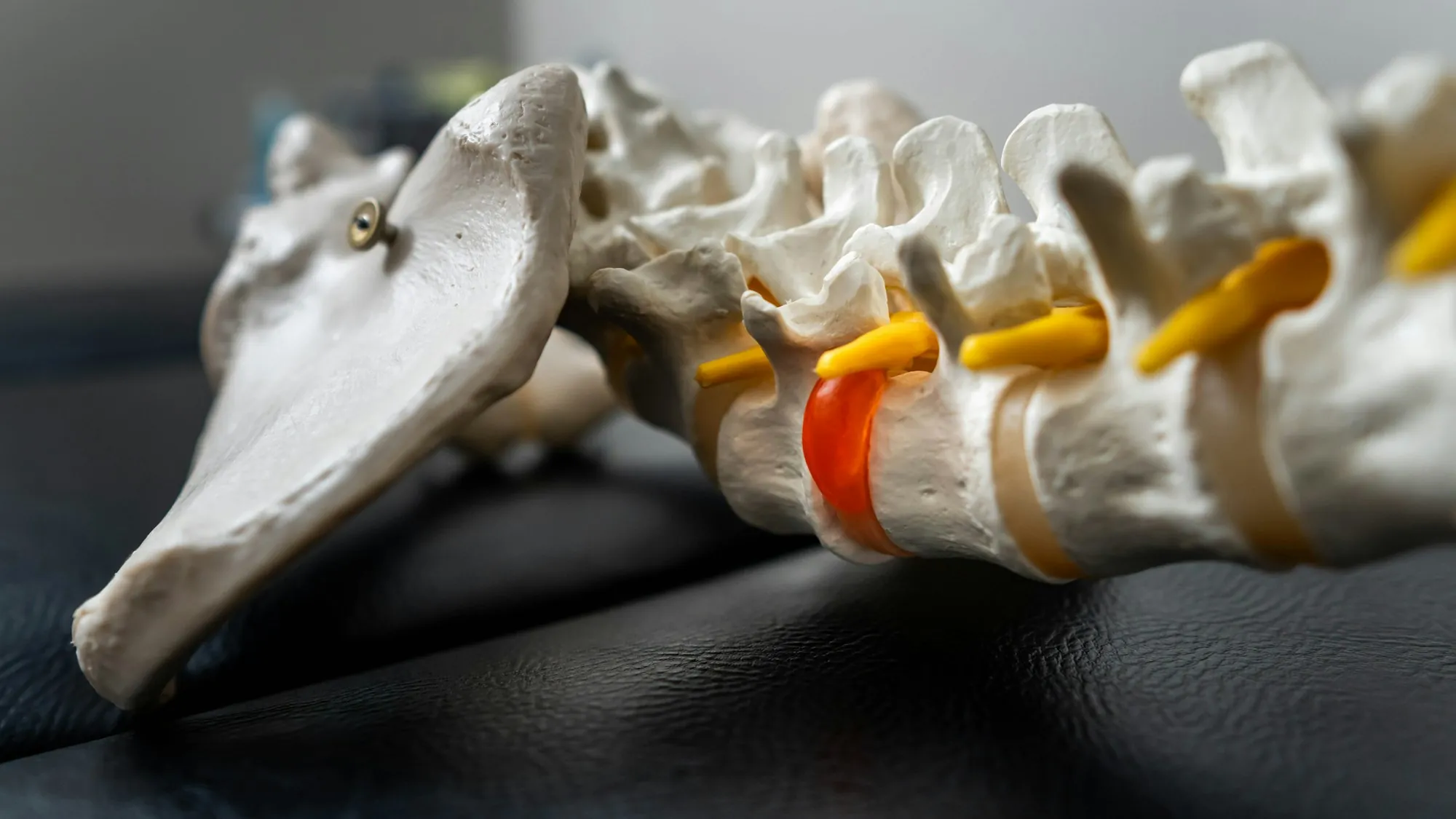
As we get older, the discs between the vertebrae gradually lose water and become thinner and less flexible. These changes are called disc degeneration. Despite the name, degenerative disc disease is not really a disease; it is a normal part of ageing.
Disc changes are very common on scans, including in many people who have no pain at all. For this reason, scan findings alone do not explain someone's pain.
In some people, worn discs are linked to back or neck pain, or lead to other problems such as a herniated disc or narrowing of the spinal canal. Most people are treated without surgery.
02
Signes d'alerte : demandez de l'aide immédiatement
Certains symptômes nécessitent une prise en charge médicale urgente. N'attendez pas un rendez-vous si vous présentez l'un d'entre eux.
- Numbness or tingling around your bottom, genitals or inner thighsCall 999 or go to A&E.
- New difficulty passing urine, or loss of control of your bladder or bowelsCall 999 or go to A&E.
- Weakness or numbness in both legs, or weakness that is getting worseCall 999 or go to A&E.
- With neck problemsNew clumsy hands, difficulty walking or loss of balance: get urgent medical help.
Urgence999Au Royaume-Uni, appelez le 999 ou rendez-vous immédiatement aux urgences (A&E) pour tout signe nécessitant des soins d'urgence.
En Europe112En Europe, appelez le 112 ou rendez-vous au service des urgences le plus proche.
Pas une urgence111Pour un avis urgent qui ne relève pas d'une urgence vitale, appelez le NHS 111 ou votre médecin traitant.
03
Symptômes
Les symptômes varient d'une personne à l'autre. Les symptômes fréquents sont notamment :
- 01Back or neck pain, which may come and go
- 02Stiffness
- 03Pain that is worse with sitting, bending or lifting
- 04Pain spreading to the buttocks, legs or arms, if nerves are affected
- 05Many people have no symptoms
04
Causes
- Natural ageing of the discs
- Genetics, which play an important part
- Previous injury
- Smoking
- Heavy physical work and being overweight, which may contribute
05
Diagnostic
Diagnosis is based on your symptoms, an examination and, where helpful, scans. Because disc changes are so common, the important question is whether they explain your symptoms. This is judged by looking at your symptoms and scans together.
Examens pouvant être réalisés
- Medical history and physical examination
- MRI scan, where needed
- X-rays, sometimes, including standing or bending views
- CT scan, in some cases
06
Options de traitement
Tout le monde n'a pas besoin d'une opération. Les options non chirurgicales, comme la kinésithérapie, les médicaments et les infiltrations, sont toujours envisagées en premier lorsque c'est approprié.
07
Convalescence
Symptoms often come and go. Many people find that pain settles over time, and regular exercise helps them stay active and manage flare-ups.
Quand consulter
See your GP or a physiotherapist if pain is affecting daily life or not improving. Seek urgent help for any of the warning signs on this page. A specialist spinal opinion may help if you have nerve symptoms or have been told your scan shows disc degeneration and want to understand what it means.
Les informations de ce site sont données à titre général et ne remplacent pas une consultation avec un professionnel de santé qualifié. Avertissement médical
Relecture clinique en attente